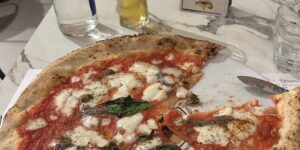
A few weeks ago, my departing editor at WhiskedFoodie.com gave me some last words of advice: “You’ve been neglecting meat! Don’t forget to include some good meaty dishes in your recipe repertoire.”
“Dang, she’s right,” I thought. I used to make a conscious effort to develop meat recipes, which I myself don’t eat much of, but in recent months I’d fallen off. In fact I couldn’t think of the last meat recipe I’d done.
During our family road trip, I replaced the salami and mortadella on my Central Grocery muffuletta with hard-boiled egg. “That’s a damn shame,” one friend said.
So I started thinking a lot about meat. Why had I been avoiding it? My own eating preferences aside, a bit of introspection revealed I was actually kind of scared of cooking meat. So many different cuts and grades, dry heat and moist heat and internal temperatures…I was intimidated. As I thought back on my cooking experience, I realized I’d always shyed away from meat, delegating it to the men in my life or sticking to “safe” stuff like ground turkey and boneless skinless chicken breasts.
...and nothing like this.
It was time to light up the grill and change all that. And who better to guide me down the meaty path than the Texas BBQ and Tex-Mex king, my very own pops? He was delightedly surprised to hear about my newfound interest in carne and gladly agreed to be my meat mentor. And so began a very protein-rich week of learning, tasting, and bonding over bones, burgers, and more. read more On a Meat Mission »
The first ramen I ate in L.A. was on a trip back in 2009. Our plane got into LAX around nine at night and by the time we got to the Grand Kyoto Hotel, I was starved. It was way past 10 pm and most of the restaurants in the neighborhood were closed. But the ramen shops on 1st Street in L.A.’s Little Tokyo neighborhood, right around the corner, were open until midnight or later. And getting a bowl of late-night ramen is a very hipster thing to do.
By 11 pm, Dainkokuya Ramen and most of the other highly recommended ramen stands were packed and there were quite a few people ahead of me on the waiting list. I was way too hungry to wait, so I settled for the quieter scene at Mr. Ramen, where I ordered the roast pork ramen soup. The fresh noodles were excellent, and the dark brown-colored broth was deepy satisfying. The big slices of pork loin were wonderfully tender. The hard-boiled egg garnish was perfect.
Roast Pork Ramen
A few nights later, I visited a ramen shop called Orochon Ramen, which is known for spicy noodles. I ordered the red chile paste noodles on the regular menu and loved them.
Not long ago, very traditional Japanese restaurants like Teppay on Westheimer were the only places to get ramen in Houston. They offer a little shaker of Japanese peppers on the side, but spicy ramen is still pretty much virgin territory around here. I suspect that will soon change.
In L.A., Orochon Ramen got a lot of noteriety for a special menu of melt-your-face-off, hotter-than-hell noodle bowls. The place is famous for its challenge — eat the #2, probably the spiciest bowl of noodles in L.A. in 30 minutes or less, and you get your picture on the “Wall of Bravery.” Adam Richman did this bit on Man vs. Food. While I was there, a Vietnamese-American guy from Houston was doing the challenge. He was only halfway through the bowl, and he didn’t look like he was having much fun. I don’t think he made it.
Here, for your amusement, is a video record of one man’s successful attempt to make the Orochon Ramen “Wall of Bravery.”
The pork in the Tonkotsu ramen at Teppay on Westheimer is as tender as the roast pork Grandma served for Sunday dinner.The pork bone broth is milky in color and intensely flavored, which is typical of this style of ramen. (No, we are not talking about the little packages of instant noodles you ate in your dorm room in college–this is the real deal.) There are over 20 regional varieties of ramen in Japan, and food-loving Texans are studying up on all of them in preparation for the tsunami of noodle soup that is about to flood over us. How else will you avoid confusing traditional Tonkotsu pork BONE ramen with the Americanized Tonkatsu pork CHOP ramen.
Tonkotsu (豚骨, “pork bone”; not to be confused with tonkatsu) ramen usually has a cloudy white colored broth. It is similar to the Chinese baitang (白湯) and has a thick broth made from boiling pork bones, fat, and collagen over high heat for many hours, which suffuses the broth with a hearty pork flavor and a creamy consistency that rivals milk, melted butter or gravy (depending on the shop). Most shops, but not all, blend this pork broth with a small amount of chicken and vegetable stock and/or soy sauce. The noodles are thin and straight, and it is often served with beni shoga (pickled ginger). In recent years the latest trend in tonkotsu toppings is māyu (sesame oil), a blackish, aromatic oil made from either charred crushed garlic or Sesame seeds. It is a specialty of Kyushu, particularly Hakata-ku, Fukuoka (hence sometimes called “Hakata ramen”).
The ubiquity of Vietnamese noodles shops serving pho and mi in Texas and the relatively small size of the Japanese community here has isolated us from the ramen binge that the rest of the country has been experiencing since David Chang’s Momofuku Noodle Bar took off in New York nine years ago.
But now our long ramen drought is about to end. I have read your fortune, and I see a bowl of ramen in your immediate future. It won’t be long before Texans join fellow American ramen nerds who are flying to Japan and learning the language in order to enjoy the soup properly. (Please share your ramen adventures.)
If you don’t have the time or funds to visit Japan, then you must, at the very least, rent the ramen cult movie Tampopo as soon as possible and learn all about the ramen cowboys, Goro and Gun.
My friend George Motz, the author of Hamburger America, has a new TV show on the Travel Channel called Burgerland. On each episode of the show, George hits a new city and visits four burger joints–three from his book and one suggested by a local. I was the local and I introduced George to Stanton’s City Bites on Houston Ave in the old First Ward. He got a bacon cheeseburger and a Saint Arnold’s Root Beer. Watch for the Houston episode of Burgerland on the Travel Channel sometime in May.
HOUSTON – (Jan. 28, 2013) – Today, SagaCity Media President Nicole Vogel announced the full editorial and art staffs for the April launch of Houstonia magazine, a new monthly publication aimed squarely at the residents of America’s fourth largest city. The brainchild of two Houston natives, and with a staff packed with top local talent, Houstonia is poised to become an indispensable publication for the Houston area’s 6 million residents, as well as the city’s only paid monthly title with content solely produced by and for Houstonians.
While I have always advised my brilliant and talented daughter, Katie Walsh, to find something better to do, I have been secretly delighted at her progress as a food writer. Amazingly, she has lately put together enough freelance work to make a living at it. After watching her diligently photograph nearly everything we ate on a recent road trip for her blog on the Whisked Foodie website, I asked her to do a guest blog about the trip here.
Katie, and her sister Julia Walsh are in their early twenties. I was so broke during my early years as a freelance food writer that when Katie and Julia were young, our family vacations were mostly car trips to visit relatives. The kids were greatly amused when I would sometimes do a cooking lesson for my relatives’ friends and neighbors and autograph cookbooks I brought along. They thought I was a celebrity; I did it for the gas money. And while we skimped on hotels, a Walsh family road trip always involved lots of good eating.
The children of my second marriage, Ava and Joe Walsh are being indoctrinated into the road eating routine by their older sisters. Here’s Katie’s story:
Road Trip!
by Katie Walsh
The Walshes recently returned from a road trip to Tyrone, Georgia for a family wedding, which was of course rife with good times and good eats. My sister Julia and I have been road tripping with Dad since we were tots, so this time was especially cool, being able to welcome our siblings Ava (6) and Joey (4) into the tradition.
We took I-10 from Houston to Mobile before turning north toward Atlanta. The Gulf coast portion of this route is one that Julia and I hold near and dear, after having done it countless times to go see our Nana in Florida. But it was new to the wee ones, which made it really fun and exciting to share.
Our first stop was in Breaux Bridge, Louisiana, for boudin at the legendary meat market Poche’s. Here’s Julia teaching Ava and Joey how to squeeze the filling from a hot crawfish link.
Poche’s holds a special place in my heart. I ate my first taste of boudin on their little covered porch, and now there we were again, at the same picnic bench, while Ava and Joe got their first taste. They took it very seriously.
While she was working on the Mama Sugar film for Foodways Texas, filmmaker Keeley Steenson put together this short “recipe video” about Mama Sugar’s legendary sweet potato cobbler. (The recipe appears in my book Texas Eats.)
A preview of the Foodways Texas Mama Sugar film was shown at the Saint Arnold brewery during the Foodways Texas BBQ film festival earlier this fall. The completed movie will be released at the Foodways Texas BBQ Symposium this spring.
Meanwhile, Mama Sugar’s Sweet Potato Cobbler was an official selection of the 2012 New York and Chicago Food Film Festival. Congratulations to Keeley Steenson!
Gustavo Arellano’s oft-stated opinion that “Tex-Mex is dying,” has been forwarded to me repeatedly by Tex-Mex enthusiasts. They think I should challenge him to a debate–or a duel. Few people seem to realize that Gustavo and I are friends and allies.
Gustavo will be in Houston on Thursday. He will launch the The University of Houston Food for Thought Lecture Series at 5 p.m., Thursday, Nov. 15 at the Roy G. Cullen Building, Room 104 with a discussion of his new book, “Taco, USA. How Mexican Food Conquered America.” The event is free and open to the public. Afterwards, he will sign books, then he and his entourage will dine at El Real Tex-Mex Cafe at 1201 Westheimer. If you miss the lecture, come by and say hi to Gustavo at El Real at 8 or 8:30 pm.
When Gustavo says “Tex-Mex is dying,” he means that Tex-Mex had its heyday in the early 20th Century. Its influence was enormous; adding such items as picante sauce, chili con carne, chili dogs, Fritos corn chips and bean dip, nachos and chile con queso among others to the American culinary mainstream. But he’s right in pointing out that, with a few exceptions, once popular Tex-Mex chain restaurants outside of Texas have declined. As a Southern Californian, Gustavo is loyal to his own brand–Cal-Mex.
Cal-Mex, characterized by crispy tacos and burritos, is now the dominant strain across the country. Cal-Mex was popularized by taco stands that sprang up in suburban neighborhoods of Los Angeles beginning in the 1950s and 1960s. When Glen Bell combined the Americanized crispy taco with assembly line mass production techniques in the LA suburbs, he gave birth to the chain that now exemplifies Americanized Mexican food–Taco Bell.
Of course, here in Texas, news about the death of Tex-Mex has been greatly exaggerated. And we Tex-Mex lovers take the national success of our Cal-Mex rivals with a large dose of sour cream. If Taco Bell is the best example of the national spread of Cal-Mex, well then, they won and “bless their hearts.”
But Gustavo and I are united in our enthusiasm for Americanized Mexican foods, both as a window on the bicultural traditions of the border and as tasty and popular American regional cuisines. And we both have pointed out that the culinary establishment’s preference for “authentic Mexican food” is actually a prejudice against Mexican-Americans.
Gustavo calls the authentic Mexican mafia “Baylessistas.” If you point out that they hate Cal-Mex and Tex-Mex because they like their Mexicans to stay in Mexico, they say things like: “What do you mean I’m racist? I have all of Diana Kennedy’s books AND I ate at Frontera Grill!” Gustavo mocks hilariously.
In his Oxford American article, “Savoring Mutt City,” Southern Foodways Alliance Director John T. Edge called Houston the “the South’s twenty-first century Creole capitol…the most vital place to eat in the South right now.” In this series we offer a taste of what he was talking about.
Did you know that the best fried chicken in Houston is served at a mom and pop Middle Eastern restaurant on Richmond called Al Aseel Grill & Cafe, “The Taste of Bethlehem?” (I bet you didn’t know that Bethlehem means “house of meat” in Arabic either.) Okay, granted you have to like garlic and zaatar on your chicken, but seriously, who doesn’t? It kind of reminds me of the garlicky “New Orleans confetti” the late Austin Leslie used to sprinkle on the Creole Fried Chicken he served at Jacques-Imo’s.
Al Aseel is one of three Middle Eastern restaurants at the corner of Richmond and Dunvale. Zayad and Cedars Bakery are the other two. You’ll find the flavors of Iraq, Lebanon and the West Bank in these three humble eateries. There’s also a taqueria and a Caribbean food truck on this corner, but I’ll get around to those another time.
Jim Sherman, my gardening guru, told me to meet him at a raised bed garden this morning. He was trying to clean the place up to get it ready to plant the fall and winter crops. The last plants left over from the summer were peppers and they were out of control. There were so many red ripe cayenne and tabasco peppers he couldn’t pick them all. The birds were having a field day. He had been reading the series about Homemade Pepper Sauces on this blog and knew I could put some peppers to good use.