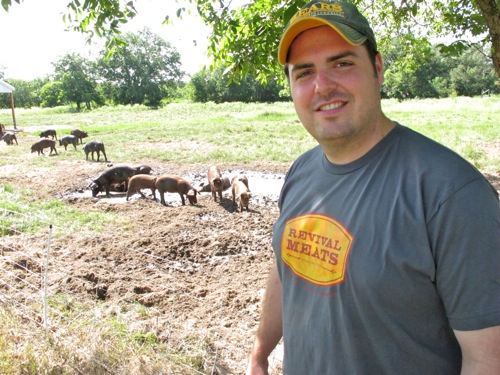
If you shop at the Farmer’s Market on Richmond, you have probably met Morgan Weber at the Revival Meats booth. Last week, Morgan took me to visit his pig farm in Yoakum. The American pork industry produces very inexpensive meat in its factory farms. But some consumers and many chefs would rather pay higher prices for premium pork grown locally with more fat, more flavor, and sustainable agricultural methods.
Morgan’s farm raises some of the heirloom breeds that chefs rave about–like the wooly Mangalitsa pigs, a breed that was raised primarily for lard in Europe. He also raises Red wattle hogs, a Texas crossbreed that is well-adapted to the heat and prone to grow very large, very fast.
The pigs are penned in by movable fences so that after they muck up one pasture, they can be moved to another one. I sort of envied one group of 300- pounders that were wallowing in a muddy pond under a live oak tree to escape the August heat. They looked quite happy in their muddy swimming hole.
In the wake of H1N1 flu, Michael Pollan and other food writers are raising questions about the American pork industry’s factory farms and the ethical, environmental and public health issues that surround them. Small pig farmers like Morgan Weber offer an alternative to environmentally-conscious pork consumers. Tastes good too!
Later in the week, I’ll give you some recipes for Revival Meats pork products.
I frequently purchase pasture-raised poultry, beef and pork like the pigs at Revival Meats and without a doubt in my mind the greatest difference in the taste of the meat is pork. I don’t know if it’s a function of the pasture raising or the breeds used but it’s so much better than standard factory farm pork.
Morgan is a great guy and so passionate for what he does. Revival Meats now has a showcase at Houston DairyMaids’ on Airline south of Canino’s every Friday afternoon during Lindsey’s cheese-tastings. Go talk with him at Urban Harvest, too!
Any word on how they’re coming with the lamb production?